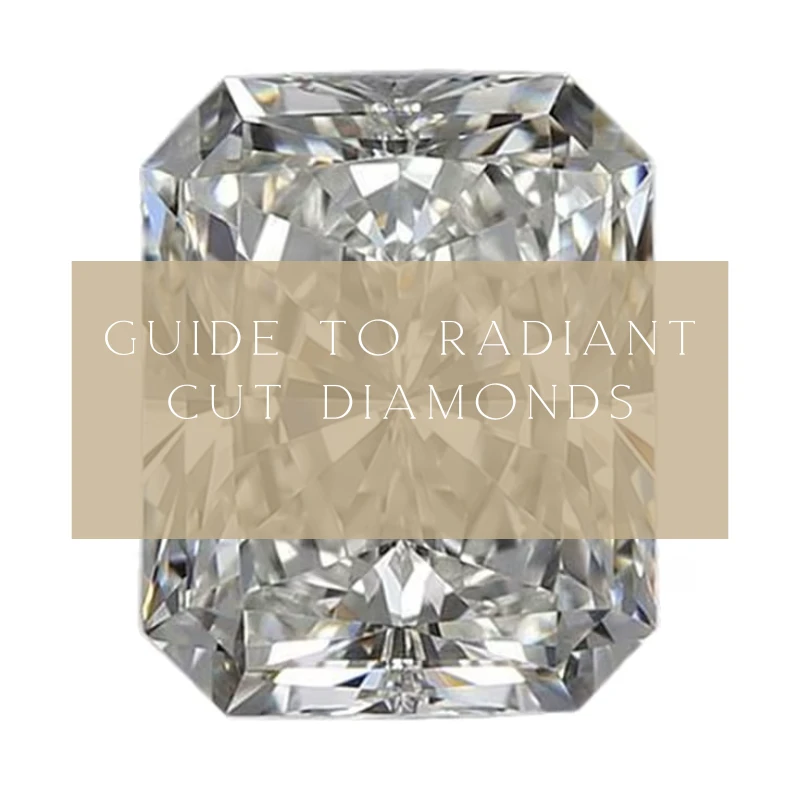
The radiant cut diamond is a bold and brilliant hybrid, combining the sparkle of a round brilliant with the shape and structure of an emerald or princess cut. Known for its cropped corners and dazzling faceting, the radiant cut is a perfect choice for those seeking a modern diamond with maximum brilliance and a strong presence.
Whether square or rectangular, radiant-cut diamonds offer a high-energy sparkle with a refined outline—ideal for solitaires, halos, or three-stone rings.
The Story of the Radiant Cut
Introduced in the 1970s by master cutter Henry Grossbard, the radiant cut was developed to offer the best of both worlds: the fire and brilliance of a round cut and the shape and strength of a step-cut stone.
Featuring 70 facets, the radiant cut is considered a brilliant cut and is designed to maximise light return. Its cropped corners give it added durability, making it less prone to chipping than other square or rectangular shapes like the princess cut.
Radiant cuts are available in both square and rectangular ratios, offering flexibility depending on your style preferences.
What to Look for in a Radiant Cut Diamond
With its complex faceting and versatile shape, the radiant cut requires close attention to proportion and light performance.
Colour
Radiant cuts tend to show more colour than round brilliants due to their depth and shape. To maintain a bright and white appearance, choose a stone in the G–H colour range.
For warmer settings like yellow or rose gold, I colour diamonds can still appear luminous while offering better value.
Clarity
The brilliant cut helps hide inclusions well, especially in the centre of the diamond. However, clarity still matters—particularly for larger stones.
We recommend clarity grades in the VS–SI range, as long as the diamond is eye-clean. Inclusions near the corners or edges should be avoided to maintain the strength of the stone.
Cut
GIA does not assign a cut grade for radiant diamonds, so visual inspection is key. Symmetry, outline, and light return should all be evaluated carefully.
-
A length-to-width ratio of 1.00 to 1.05 will result in a square shape.
-
Ratios from 1.15 to 1.30 will produce a more rectangular silhouette.
-
The corners should be evenly trimmed and the brilliance should be evenly distributed across the stone.
Radiant cuts may show a mild bowtie effect, but well-cut stones minimise this and sparkle across the entire surface.