When buying a diamond, most people first look at carat weight, colour and price. But the diamond certificate is just as important. This document sets out the characteristics of the stone as determined by an independent laboratory. For many buyers, however, such a report can seem like a collection of technical terms.
That is why we explain how to read a diamond certificate, what you should really pay attention to and the differences between GIA, HRD and IGI.
What is a diamond certificate?
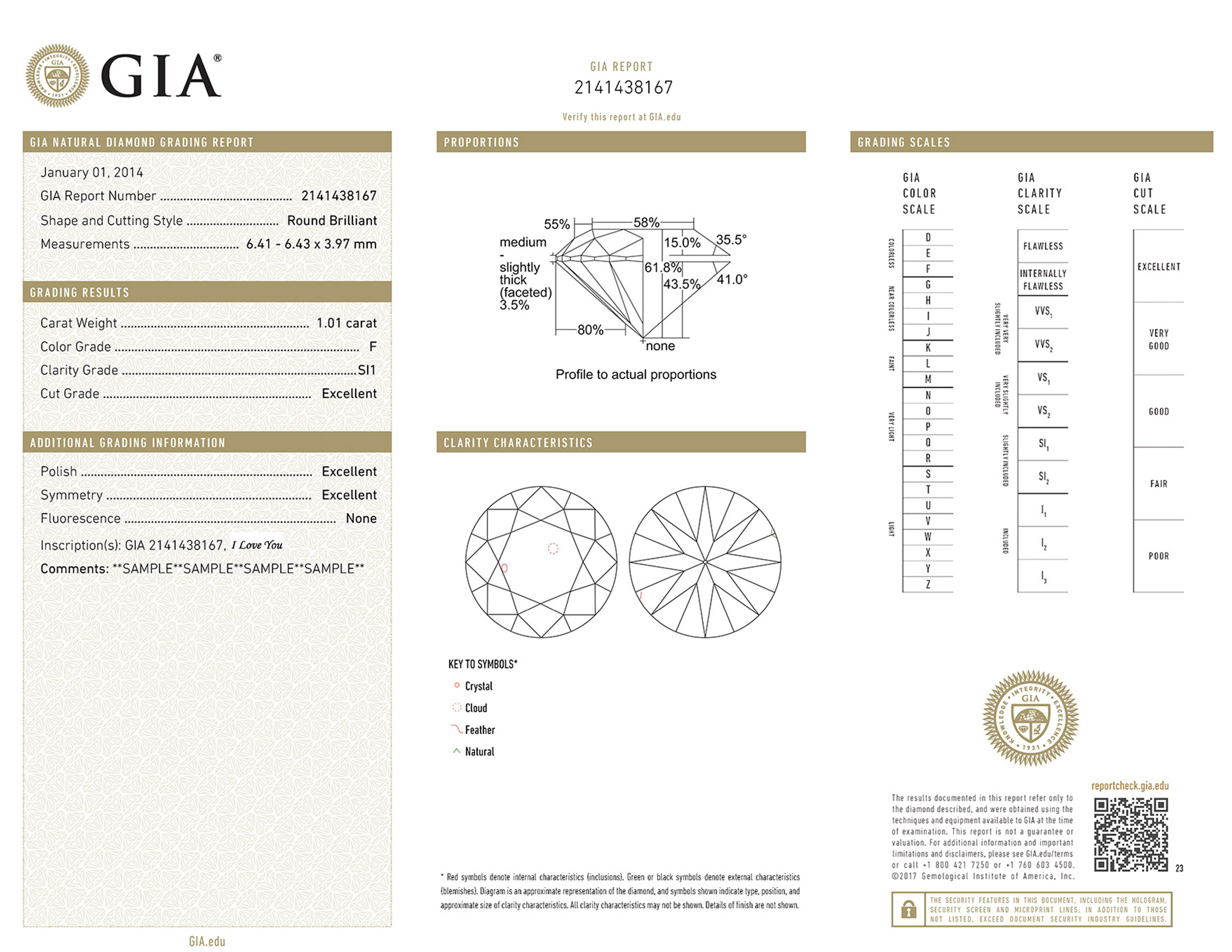
The term diamond certificate is widely used, although laboratories generally refer to the document officially as a grading report or diamond report. It is not a valuation, nor is it a guarantee that a diamond is worth a particular retail price. The report describes the characteristics of the diamond at the time it was examined.
The most important elements are the well-known 4Cs: carat, colour, clarity and cut. GIA developed this system as a standardised way of describing diamond quality. HRD Antwerp and IGI also use these characteristics as the basis of their reports.
1. Check the report number first
Every report has a unique number. You can use this number to verify the document with the laboratory that issued it. GIA provides its Report Check service, IGI also offers online verification, and HRD Antwerp has a digital report archive.
This is an important check. A paper document means little if the report number does not correspond with the information held in the laboratory's database.
On some diamonds, the report number is also laser-inscribed on the girdle, the narrow outer edge of the diamond. Under magnification, you can check whether this inscription matches the report.
2. Read the 4Cs
Carat refers to the weight of the diamond. One carat equals 0.2 grams. However, two diamonds with the same carat weight do not necessarily appear to be the same size, as their proportions and cut can differ.
Colour indicates how much colour is visible in colourless to lightly tinted diamonds. The scale generally runs from D, colourless, to Z, noticeably tinted.
Clarity describes internal characteristics, known as inclusions, as well as characteristics on the diamond's surface. High clarity grades such as VVS contain very small inclusions that are difficult to see under magnification. With lower clarity grades, an important consideration is whether the diamond is still ‘eye-clean’, meaning that inclusions are not readily visible to the naked eye.
Cut refers to how well the diamond has been cut. For round brilliant diamonds, this quality is explicitly graded. Cut quality has a significant influence on how light travels through the stone and, ultimately, how much brilliance and sparkle you see.
3. Look beyond the 4Cs
A good diamond certificate contains more information than just four grades or values. You should also pay attention to measurements, polish, symmetry and fluorescence.
The measurements show the width and depth of the diamond. Polish describes the quality of the finish on the facet surfaces, while symmetry indicates how precisely the facets are positioned in relation to one another.
Fluorescence describes how a diamond reacts to ultraviolet light. Fluorescence is not automatically good or bad. Its effect should be assessed in combination with the individual diamond.
Some reports also include a clarity plot: a diagram showing the position and type of inclusions within the diamond. This can help you understand why a particular clarity grade was awarded.
What is the difference between GIA, HRD and IGI?
GIA stands for the Gemological Institute of America and is the organisation behind the internationally recognised 4C system. GIA reports for natural diamonds include information such as weight, colour, clarity, cut quality, proportions and finish.
HRD Antwerp has strong ties to Antwerp as one of the world's major diamond centres. According to HRD, its Natural Diamond Grading Report confirms the natural origin of a polished diamond and describes its 4Cs. During the examination, the laboratory assesses characteristics including weight, measurements, fluorescence, colour, clarity and cut quality.
IGI, the International Gemological Institute, issues reports for both natural and lab-grown diamonds. Its reports include information such as origin, shape, measurements and the 4Cs, as well as details of any relevant treatments where applicable.
Does the diamond grading laboratory matter?
GIA is one of the most widely recognised names in diamond grading worldwide, which can make a GIA report particularly familiar to buyers internationally. HRD Antwerp and IGI are also established independent gemmological laboratories, each with a strong presence in different parts of the market.
At Diamond House Jewellery, we work with diamonds graded by GIA, HRD Antwerp and IGI. We see the grading report as an important part of evaluating a diamond, rather than the only factor that determines its quality or value.
For buyers, the laboratory is therefore one factor to consider, but not the only one. The grading report should be considered alongside the diamond’s actual characteristics, appearance, price and your personal preferences.